




On this page
Gambling Book Reviews
Introduction
Here are my personal reviews of a whole host of gambling books. I hope they motivate you to learn more about how to prepare yourself to face the casinos. If you do wish to buy any of these books just click the link and you’ll go straight to the Amazon order page.
Books I recommend are indicated with a star. I am including links even to the books I don’t like, just to be consistent and fair, not to encourage you to buy them.
Book Categories: Gambling in General | Blackjack | Other Games | Fiction
Books about Gambling in General
American Mensa Guide to Casino Gambling by Andrew Brisman
Here is a book I would be proud to have written myself. The information and advice are very accurate, and the author is quite witty and descriptive, unlike other gambling writers who can be a bit dry (ahem).
Ask Barney: An Insider’s Guide to Las Vegas by Barney Vinson
Questions and answers from a man with 30 years experience in the casino business. Overall I find the book enjoyable, educational, truthful, and funny. One of the most enjoyable books about Las Vegas and gambling on the market.
Beat the House by Frederick Lembeck
If you want a book on nothing but betting systems this would be a good choice. In the event his systems don’t work can you use his excuse on page 6, “For some unknown reason the law of probability is much harsher in casinos than it is at your kitchen table.”
Beating the Casinos at Their Own Game by Peter Svoboda
This is a nice looking book with a glossy cover, lots of colorful diagrams, and good quality paper. The writing is directed toward the inexperienced player and takes plenty of time to explain the basics. However, the amount of incorrect information is very high. The blackjack basic strategy is way off, for example advising always splitting twos and threes. In the Caribbean Stud chapter the author advises raising on everything (playing blind) with three of fewer players. The Let it Ride advice is also wrong as well as the explanation about how random numbers are used in slot machines. Betting systems are given entirely too much coverage. For the beginner who needs a slow and patient teacher this book does a good job at explaining the basics of casino gambling. However the strategy advice is so often incorrect that those parts should be ignored entirely.
Beat the Players by Bob Nersesian
This book is in a class by itself. It is all about the legality of advantage play, and what what happens when casino security guards confuse advantage play for cheating. Author and attorney Bob Nersesian is a hero of mine in the world of gambling.
BeatWebCasinos.com: A Shrewd Player's Guide to Internet Gambling by Bill Haywood
This book offers plenty of advice to those seeking to profit from online casino bonus incentives. There is lots of discussion about camouflauge, record keeping, and avoiding casinos that are slow or argumentative about paying. There are also lists of milk (good), beef (bad), and poisoned beef (very bad) online casinos along with comments on various software providers and online casino portals (including mine). I respect this book for not trying to sell itself with big promises of easy money (as many other books do) but rather it is very honest and straightforward about the problems the bonus hustler is likely to encounter. Speaking from personal experience I strongly agree the overall content of the book. One correction I’d like to point out, the address of this web site is no longer TheWizardOfOdds.com but is now simply WizardOfOdds.com. Bill has the old address on page 181. Other than that a very good job Bill!
Behind the Black Dome by T. Dane
This book was written by a former casino surveillance operator. The book starts with an explanation of what the role of surveillance is, and isn't, in a casino. The bulk of the book explains how surveillance thinks and what they look for to catch advantage players. The book is 165 8.5" x 11" pages. At a cost of $90, it may not be for everybody, but for those trying to stay a step ahead of surveillance, or considering working for them, it may be worth the money.
Casino Games by John Gollehon
The author covers eight different games with a mixture of commentary and analysis. There were some minor problems: the blackjack basic strategy is wrong in a few places (for examples splitting 9s against a 7) and his explanation of slot machine mechanics is outdated.
Casino Gambling for the Winner by Lyle Stuart
This book combines decent edge cutting advice with myth. The author spends a lot of time explaining how to look for trends which in the long run will not help the player.
Casino Tournament Strategy by Stanford Wong
A very good primer on playing casino tournaments. The advice applies to all games.
The Complete Idiot’s Guide to Gambling Like a Pro by Stanford Wong and Susan Spector
Game by game the authors go through the rules, the method of play, the optimal strategy, and the house edge. This is the book I turn to first when I am not sure about something. Written in plain simple English that even the most clueless person should be able to understand.
The Doctrine of Chances: Probabilistic Aspects of Gambling by Stwart N. Ethier
Reveiew coming soon.
The Everything Casino Gambling Book by George Mandos
I only took a brief look at this book in the bookstore and noticed the following advice in the chapter on Caribbean stud poker the author says, “Another good tactic is if you have a pair that is higher than the dealer’s up card, then stay; otherwise fold your hand.” This is an extremely risk averse strategy that I can not recommend, costing the player up to 1.61 units each time.
Exhibit CAA: Beyond Counting by James Grosjean
This is the second edition of Beyond Counting. The “Exhibit CAA” is an inside joke that is explained on page iv. The first edition was 223 pages and can be bought on Amazon, and this one triples that to 669, but is extremely difficult to buy. Not only is this likely the biggest gambling book ever written, but the most expensive. Just about every page breaks fresh ground, excluding the first edition. Some of it very esoteric, like how to count the Royal Match side bet, which even the author admits is a weak advantage play. Many pages are directed towards hole card readers, especially those who play unusual games. There is also some good practical information, like how to sneak into terminal C at the Las Vegas airport, which at times has enormous lines at security. In some of the driest parts, just as your eyes are starting to glaze over, Grosjean surprises you with some very witty humor, often in the footnotes. He also goes after some of the biggest names in the world of gambling writers with irreverence, including my own. I would recommend this book for only the most serious advantage players, mainly those exploiting unusual games or hole carders, as well as those with college-level interest in gambling mathematics. If this book were for you, chances are that you already have it.
Extra Stuff: Gambling Rambling by Peter Griffin
This book is a collection of miscellanous articles by gaming expert Peter Griffin. A great book if you are interested in the fine points of the mathematics of gambling but I wouldn’t recommend it for the mathematically challenged or the casual gambler.
Finding the Edge edited by Olaf Vancura, Judy A. Collins, and William R. Eadington
This book is a collection of academic papers covering a host of gambling topics. A strong math background would be strongly suggested to get the most out of this book. The writing is very professional and I'm sure a huge amount of work went into its creation. Some of the greatest minds in gambling have contributed papers. However this book is not for the average person but for the person with an interest in mathematics and gambling.
Fortune’s Formula by William Poundstone
This book is about the story, emphasis story, behind the Kelly Criterion. Most of the book is devoted to the biographies behind the Kelly Criterion’s greatest believers and skeptics. Only about 5% of the book is devoted to the mathematics of the Kelly Criterion itself, and that math is introductory. Although I skimmed large chunks of the book, I found it to be very well written, balanced, and researched.
The Frugal Gambler by Jean Scott
This book is all about milking the casinos for all the free means, rooms, and other freebies for all they are worth. It isn’t difficult to have an entire Vegas trip paid for by getting the most out of coupons and slot clubs. Jean Scott shows you how to do it. Nobody knows the topic better than her, for she is the Queen of Comps.
Gambling 102 by Michael Shackleford
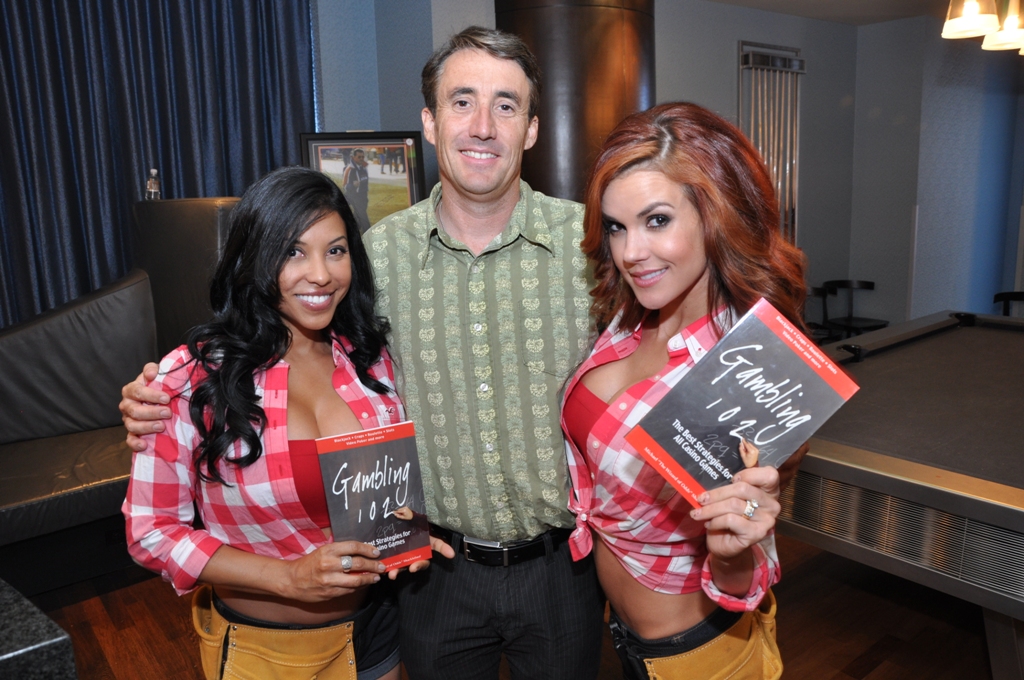
It wouldn't be appropriate to review my own book, so I suggest checked the reviews at Amazon. Gambling 102 was rated the 4th best gambling book at casinoonline.co.uk.
Gambling Wizards by Richard W. Munchkin
This book is a collection of interviews of some of the most successful gamblers in the world. It probably isn’t what you expect. From golf to backgammon there are plenty of great stories to keep you turning the pages. I read the whole thing in a week, which is very unusual for me.
How to Gamble in a Casino by Tom Ainslie
This book is another combination of decent edge cutting advice and betting systems.
How to Win at Gambling by Avery Cardoza
This is a fine, to the point, book covering fifteen games and a chapter on money management. The style is much like my own, skipping the chit chat and getting right to the facts. For the gambler with some experience who just wants to cut down the house edge I would recommend this one over all others. The only error I have seen is that he falsely suggests you raise on an unsuited (10,J,Q) or (J,Q,K) in let it ride. These plays have an expected return of 97.7 and 89.5 cents on the dollar respectively.
The Man with the $100,000 Breasts and Other Gambling Stories by Michael Konik
This book is an easy to read and hard to put down collection of stories about various gamblers and gambling topics. One chapter on the new casino games was quite well done. However the author incorrectly states that the difference in house edge in Caribbean Stud Poker between optimal strategy and raising on ace-king-jack-8-3 or better is .00000025%. Actually the house edge using optimal strategy is 5.224% and using ace-king-jack-8-3 is 5.316%, for a difference of 0.092%. The author also claims the house edge in Spanish 21 to be 0.8%. According to my analysis the house edge is closer to 0.7%. He also neglects to say that the player should opt for double down surrender on 17 against an ace. However don’t let my nit picking keep you from reading this book. It is a real page turner and you will probably learn a lot about gambling without realizing it.
More Frugal Gambling by Jean Scott
This is a follow up to Scott’s “The Frugal Gambler.” Both books contain great advice on how to get the most out of Vegas on a tight budget.
Scarne’s New Complete Guide to Gambling by John Scarne
Scarne is one of the pioneers in modern gaming analysis. Most authors have a “get to the point” philosophy yet Scarne devotes much more time than most to discussing the odds. Unfortunately his advice is still incorrect sometimes, for example of the poor blackjack advice the author advises hitting a 12 vs. a dealer’s 4 and never splitting 4s, 6s, or 9s.
Optimal Play edited by Stewart N. Ethier and William R. Eadington
This 550-page book is comprised of academic-level articles on a host of gambling topics. My favorite was “Are Casinos Paranoid? Can Players Get an Edge by Sharing Information” by James Grosjean. Many of the other articles are rather esoteric in nature, and are extremely math heavy. College-level math is required to appreciate most of them. Personally I skimmed most of it. It will be a good resource to have on my bookshelf.
Secrets of the New Casino Games by Marten Jensen
This is a very good idea for a book covering games difficult to find in most other books. The author covers in detail Let it Ride, Caribbean Stud Poker, Three Card Poker, Pai Gow Poker, Spanish 21, Red Dog, Sic Bo, and Casino War. Unfortunately too much of the advice is wrong for me to award the book with a star. For example the author recommends raising in Carribean Stud Poker with Ace-King-Jack-9-5 or better. Ignorring the dealer’s card, the correct breakeven hand is Ace-King-Jack-8-3. The Let it Ride strategy advises letting it ride on any three to a straight flush which is not always a good bet. Although these are minor mistakes, the entire chapter on Casino War is seriously flawed by the assumption that “your chances of getting a tie are only 1 in 17” (page 130). With 13 ranks in the deck the correct odds are just under 1 in 13. This is probably why the author incorrectly advises surrendering on a tie when it is actually better to raise and go to war. However if you tear out the Casino War pages the other problems are minor enough to merit buying and using.
Silberstang’s Encyclopedia of Games and Gambling by Edwin Silberstang
In this book the author covers both casino and non-casino games, from chess to strip poker. This book is an enjoyable read and with one exception seems mathematically sound. The one exception is when he states on page 110 about video poker jackpots, “But the longer it doesn’t hit, the more overdue it is.” The fact is that a royal is equally likely to hit, assuming no changes in strategy, regardless of when the last royal was.
The Unofficial Guide to Casino Gambling by Basil Nestor
This is a very fine and carefully prepared piece of work. The book’s 321 pages cover 9 games in depth, 3 briefly, and has five chapters of advice and information on gambling in general. Game by game the author explains the rules and protocol, identifies the best and worst bets, and gives advice on how to cut down the house edge as much as possible. The first two chapters state the mathematical truths that apply to all games in an easy to understand manner. Visit the author’s website for more information.
Whale Hunt in the Desert by Deke Castleman
For those unfamiliar with the terminology, gamblers range from fleas to whales. The Las Vegas casinos are very competitive to get the business of the whales. This book is all about the whales and the hosts who pursue them. The book revolves around superhost Steve Cyr but often strays away from his story. I found the book very well written and interesting. It took me only about two weeks to read it, which for me is very good time.
The Winner’s Guide to Casino Gambling by Edwin Silberstang
Definitely one of the better books in its class. The book covers seven games in depth and has four chapters on broader topics. Silberstang obviously knows what he is talking about and doesn’t oversimplify his explanations as many other books do. The writing is very rich and laced with lots of stories and lessons from the author’s own experiences. My only criticism is that he incorrectly states that slot machines are on a repeating cycle.
Books About the Gambling Business
Casino-ology by Bill Zender
This is a unique book by casino management consultant Bill Zender. He goes through many common practices casinos make that depress profits. A common theme is that casino management over-react to the fear of advantage play, while they should be focused on maximizing profits from legitimate players.
Contemporary Casino Table Game Design by Eliot Jacobson
If you are new to the business of inventing new casino games, or in a position of authority to place them in a casino, then this book should be required reading. It is a very competitive business and the author seeks to improve the odds of a game making it by avoiding commonly made mistakes.
If you didn’t find the book you were looking for, try searching at Amazon.com.