
On this page
Pai Gow Tiles
On this page
Introduction
Pai gow is the oldest of the casino games. It easily pre-dates roulette and baccarat. How such a complicated game ever got started, I have always wondered. Indeed, pai gow is a difficult game to learn. The concept is the same as pai gow poker, where both player and banker make high and low hands, and then compare against each other. What makes pai gow difficult is there is order of hands and tiles seems largely random, and is difficult to memorize.
What I love about pai gow is that for bankroll preservation, there is nothing that beats it. The pace is slow at about 30 hands per hour, and 41% of hands result in a push. If you are a pale-face, like me, you'll impress the dealer and some other players that you even understand it. However, some Asians immediately leave the table when I sit down, as if I'm unlucky. Don't be scared to try the game, even if you know nothing about the rules. You can always ask the dealer to set your hands according to the "house way." Better yet, keep reading to learn more about the game.
 Ohio Recommended Online Casinos
View All

UP TO $11,000 BONUS
All US players welcome
Over 200 casino games
Play on PC or Mobile

UP TO $3000 BONUS
Casino & Sportsbook
American players only
Play on desktop or mobile

UP TO 777$ BONUS
Large welcome bonus
Daily casino tournaments
Popular games

$7777 + 300 Free Spins
Live Dealer Games
Daily Free Tournaments
Mobile and Desktop Friendly
Rules
Following are the primary rules when it comes to pai gow. Each casino may have some its own fine points when it comes to player banking and prepaying the 5% commission.
- Pai gow is played with a set of 32 dominoes displayed below.
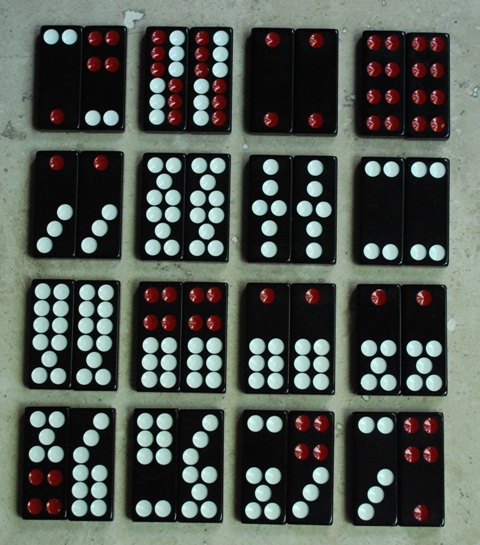
- Each player and dealer will be given four tiles.
- The player will separate his tiles into low and high hands. The player does not need to specify which is higher, as this will be obvious.
- Each pair of tiles will have a ranking order as follows:
- Pair: There are 16 pairs, as shown in the image above. The tiles are pictures in rank order, starting at the upper left, and reading like a page to the bottom right.
- Wong: This is a 2 or 12 tile with any 9 tile.
- Gong: This is a 2 or 12 tile with any 8 tile.
- 9 to 0 points (the more the better): For all other 2-tile hands, the total number of dots will be taken, and the terminal digit is used to determine the number of points (as in baccarat). For example, a 10 and 9 tile is worth 9 points; a 4 and 7 tile is worth 1 point.
- An exception to the above rule is that the two tiles in the highest ranking "Gee Joon" pair are semi-wild and are worth either 3 or 6 points, whichever results in a higher total. For example, when combined with a 4-point tile, a Gee Joon tile counts as 3 points to make a 7-point hand, instead of counting as 6 points to make a 0-point hand.
- The player's high hand will be compared to the dealer's high hand, and the player's low hand compared to the dealer's low hand (as in pai gow poker).
- If both player and dealer have a Wong, Gong, or 1 to 9 points, the tie will be broken according to which hand has the higher-ranked high tile.
- If the high tile does not break the tie then the win will go to the banker.
- A 0-0 tie always goes to the banker.
- When using high tiles to break a tie, the rank order is the same as the pair order (see picture above), except the two tiles in the highest "gee joon" pair are ranked lowest individually and will therefore never be a hand's high tile.
- If the player wins both hands he will win even money, less a 5% commission. If the player wins one and loses one then his wager will push. If the dealer wins both then the player will lose his wager.
- At most casinos, the turn to be banker rotates around the table. At some casinos, such as Foxwoods, the turn to be banker zig-zags between the player(s) and dealer, meaning that the dealer must bank at least every other hand.
- The player may invoke his turn to bank whenever it is his turn, although most players decline.
- The banker plays against every other player at the table and the dealer. The dealer will wager the same amount the player wagered the last time the dealer was the banker. More often than not, other players will sit out the hand when another player is banking, letting him or her take on the dealer alone.

Lisa with a rare two pair.
Strategy
My assistant and I have spent lots of time studying and developing pai gow strategy. Here are the strategies we have come up with so far:- Wizard Basic Strategy (added Oct. 25, 2017)
- Wizard Way
- JB Simple Strategy
- JB Advanced Strategy
A reader known as Charlie combined various parts of these strategies to create a nearly optimal strategy he could fit on a sheet of paper. He was nice enough to share it with us.
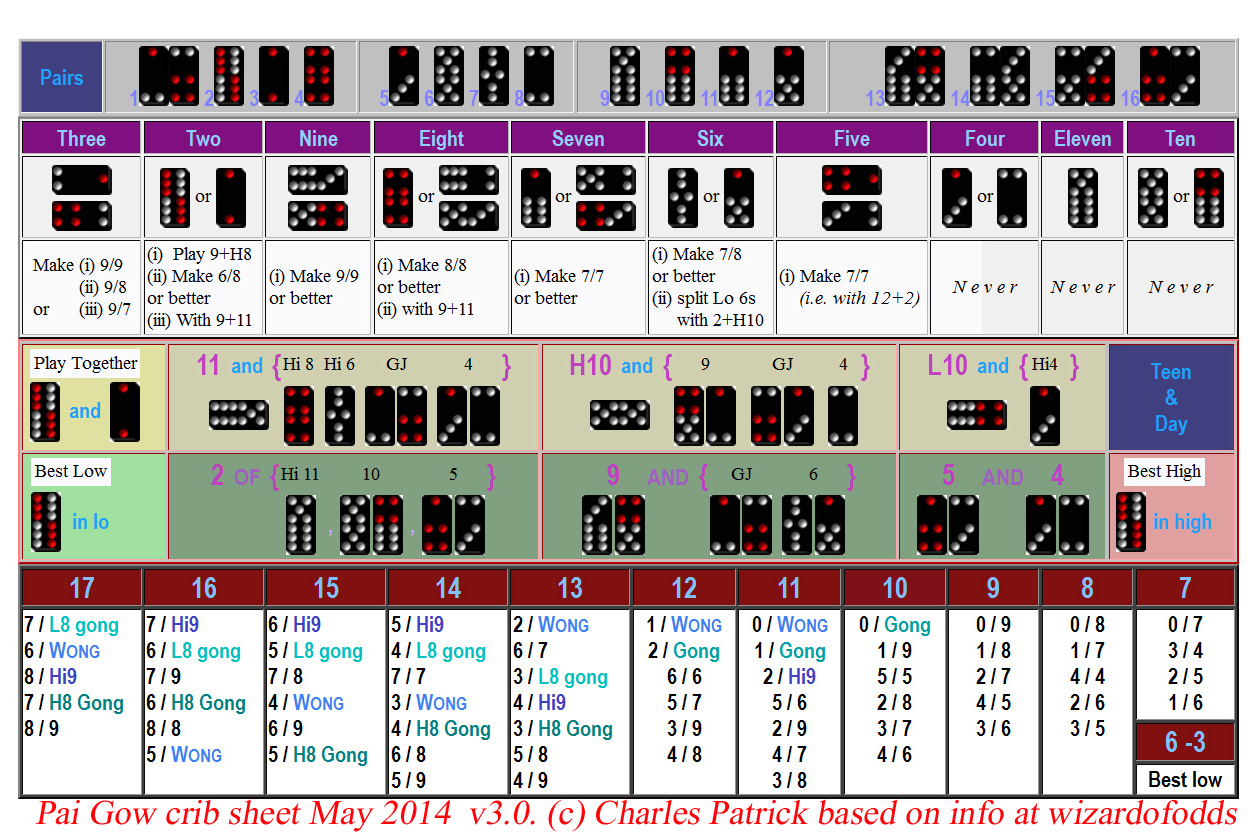
For a graphic version, click the image above for a larger version. I also have a PDF version (149K).
We also have the following strategy charts showing the correct play for every possible combination under three banking scenarios:
- Optimal Dealer Banker strategy against Foxwoods house way
- Optimal Player Banker strategy against Foxwoods house way
- Optimal Single strategy against Foxwoods house way
The next table shows the possible outcomes and house edge under various strategies, banking or not banking, and whether prepaying the commission. The table assumes the player is playing against the Foxwoods house way and a 5% commission. If the player prepays the commission, which is sometimes allowed, the house edge is reduced by 0.07%.
Pai Gow House Edge
| Your Strategy |
Banking? | Prob. Win |
Prob. Loss |
Prob. Push |
House Edge |
|---|---|---|---|---|---|
| House Way | No | 29.21% | 30.18% | 40.61% | 2.44% |
| House Way | Yes | 30.18% | 29.21% | 40.61% | 0.53% |
| Wizard Basic Strategy | No | ? | ? | ? | 1.98% |
| Wizard Basic Strategy | Yes | ? | ? | ? | 0.08% |
| Wizard Way | No | 29.07% | 29.5% | 41.43% | 1.88% |
| Wizard Way | Yes | 30.03% | 28.55% | 41.42% | 0.02% |
| J.B. Simple | No | 29.29% | 29.72% | 41.00% | 1.90% |
| J.B. Simple | Yes | 30.18% | 28.76% | 41.06% | 0.10% |
| J.B. Advanced Strategy without exceptions | No | 29.37% | 29.74% | 40.89% | 1.84% |
| J.B. Advanced Strategy without exceptions | Yes | 30.26% | 28.77% | 40.97% | 0.03% |
| Optimal | No | 29.42% | 29.60% | 40.98% | 1.66% |
| Optimal | Yes | 30.21% | 28.52% | 41.27% | -0.20% |
Inefficiencies in the standard casino house way cost the casino about 0.75% compared to optimal house strategy. If both player and dealer played optimal strategy, the house edge to the player when banking would be 0.54%, and when not banking 2.38%. For more on this topic see JB's optimal house strategy comparison table (24K). To see an enormous document on the actual optimal house strategies see JB's optimal house strategy charts (735K). I'm quite sure this is the first time it has ever been put in writing.

The perfect hand, seen at the Peppermill
in Reno. The odds are 1 in 35,960.
Prepaying the Commission
Some casinos let the player prepay the 5% commission. For example, betting $105 to win $100. This lowers the overall commission to 1/21, or 4.76%. The effect on the house edge is a reduction of 0.07%. This is an option the player should always invoke when available, yet many don't.
Betting 10% Extra as Banker
Some casinos let the player bet up to 10% more than he wagered against the dealer the last time the dealer was the banker. Assuming the player is banking every other hand, this lowers the combined house edge between banking and not banking by 0.07%.
Co-Banking
The player may make a back wager on the player acting as banker up to the amount he bet against the dealer the last time the dealer was banking. However, the player will forfeit his own turn to bank if he invokes this option. This rule will not have an effect on the overall house edge if the player is trying to maximize his action as banker (which he should), but can make the game more enjoyable if playing with friends. Rather than sitting out a hand where your friend is banking you can co-bank with him, so you're always in the game.
Calculator
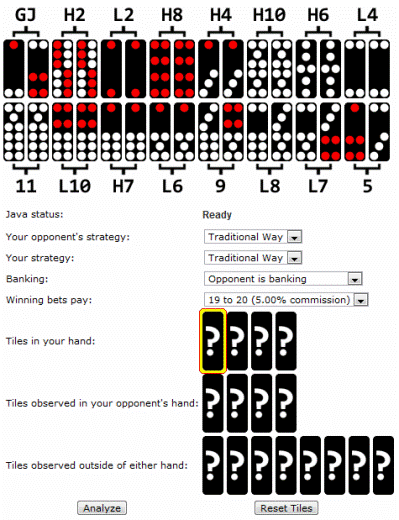
My pai gow calculator will tell you the expected value and/or strategy for any hand, with lots of other features including the effect of tiles known to be held by other players or your opponent.
Power Ratings
The following table shows the power ratings for each hand. There are four columns of power ratings, according to whether the hand is high or low, and whether the player is acting as banker or not. The power ratings are on a 0 to 100 scale, which represents the probability an opponent playing the Foxwoods house way will beat that hand.
A practical application of this table is to add the two power ratings for the three ways to set a hand, and set it the way with the highest power rating sum.
Power Ratings in Pai Gow
| Hand | Low Hand Not Banking |
High Hand Not Banking |
Low Hand Banking |
High Hand Banking |
|---|---|---|---|---|
| Gee joon | 100 | 99 | 100 | 100 |
| 6/6 pair | 100 | 98 | 100 | 99 |
| 1/1 pair | 100 | 97 | 100 | 98 |
| 4/4 pair | 100 | 96 | 100 | 97 |
| 1/3 pair | 100 | 95 | 100 | 96 |
| 5/5 pair | 100 | 94 | 100 | 95 |
| 3/3 pair | 100 | 93 | 100 | 94 |
| 2/2 pair | 100 | 92 | 100 | 93 |
| 5/6 pair | 100 | 90 | 100 | 92 |
| 4/6 pair | 100 | 89 | 100 | 90 |
| 1/6 pair | 100 | 88 | 100 | 89 |
| 1/5 pair | 100 | 87 | 100 | 88 |
| Mixed 9 pair | 100 | 86 | 100 | 87 |
| Mixed 8 pair | 100 | 85 | 100 | 86 |
| Mixed 7 pair | 100 | 84 | 100 | 85 |
| Mixed 5 pair | 100 | 83 | 100 | 84 |
| Wong with 6/6 | 100 | 80 | 100 | 83 |
| Wong with 1/1 | 99 | 78 | 100 | 80 |
| Gong with 6/6 | 99 | 73 | 99 | 78 |
| Gong with 1/1 | 99 | 67 | 99 | 73 |
| 9 with 6/6 | 98 | 61 | 99 | 67 |
| 9 with 1/1 | 97 | 54 | 98 | 61 |
| 9 with 4/4 | 97 | 53 | 97 | 54 |
| 9 with 1/3 | 96 | 50 | 97 | 53 |
| 9 with 5/5 | 96 | 49 | 96 | 50 |
| 9 with 3/3 | 95 | 47 | 96 | 49 |
| 9 with 2/2 | 94 | 45 | 95 | 47 |
| 9 with 5/6 | 94 | 44 | 94 | 45 |
| 9 with 4/6 | 93 | 43 | 94 | 44 |
| 9 with 1/5 | 92 | 42 | 93 | 43 |
| 8 with 6/6 | 90 | 40 | 92 | 42 |
| 8 with 1/1 | 89 | 39 | 90 | 40 |
| 8 with 4/4 | 88 | 38 | 89 | 39 |
| 8 with 1/3 | 87 | 35 | 88 | 38 |
| 8 with 5/5 | 86 | 35 | 87 | 35 |
| 8 with 5/6 | 84 | 33 | 86 | 35 |
| 8 with 4/6 | 84 | 32 | 84 | 33 |
| 8 with 2/3 | 82 | 31 | 84 | 32 |
| 7 with 6/6 | 82 | 31 | 82 | 31 |
| 7 with 1/1 | 81 | 30 | 82 | 31 |
| 7 with 4/4 | 81 | 29 | 81 | 30 |
| 7 with 1/2 | 79 | 28 | 81 | 29 |
| 7 with 5/5 | 78 | 26 | 79 | 28 |
| 7 with 3/3 | 76 | 25 | 78 | 26 |
| 7 with 2/2 | 75 | 24 | 76 | 25 |
| 7 with 5/6 | 72 | 22 | 75 | 24 |
| 7 with 4/6 | 71 | 21 | 72 | 22 |
| 7 with 3/6 | 69 | 20 | 71 | 21 |
| 6 with 6/6 | 68 | 19 | 69 | 20 |
| 6 with 1/1 | 67 | 18 | 68 | 19 |
| 6 with 4/4 | 66 | 17 | 67 | 18 |
| 6 with 5/5 | 61 | 15 | 66 | 17 |
| 6 with 3/3 | 60 | 15 | 61 | 15 |
| 6 with 5/6 | 59 | 14 | 60 | 15 |
| 6 with 4/6 | 56 | 13 | 59 | 14 |
| 6 with 1/6 | 55 | 12 | 56 | 13 |
| 6 with 3/6 | 54 | 12 | 55 | 12 |
| 5 with 4/4 | 52 | 11 | 54 | 12 |
| 5 with 1/3 | 51 | 10 | 52 | 11 |
| 5 with 5/5 | 49 | 10 | 51 | 10 |
| 5 with 3/3 | 48 | 9 | 49 | 10 |
| 5 with 2/2 | 47 | 8 | 48 | 9 |
| 5 with 4/6 | 45 | 8 | 47 | 8 |
| 5 with 1/6 | 44 | 7 | 45 | 8 |
| 5 with 1/5 | 43 | 7 | 44 | 7 |
| 5 with 3/6 | 42 | 7 | 43 | 7 |
| 5 with 2/6 | 40 | 6 | 42 | 7 |
| 4 with 6/6 | 40 | 6 | 40 | 6 |
| 4 with 4/4 | 37 | 5 | 40 | 6 |
| 4 with 1/3 | 33 | 5 | 37 | 5 |
| 4 with 5/5 | 31 | 4 | 33 | 5 |
| 4 with 3/3 | 30 | 4 | 31 | 4 |
| 4 with 2/2 | 29 | 4 | 30 | 4 |
| 4 with 1/6 | 27 | 3 | 29 | 4 |
| 4 with 1/5 | 26 | 3 | 27 | 3 |
| 4 with 3/6 | 25 | 3 | 26 | 3 |
| 4 with 2/6 | 24 | 3 | 25 | 3 |
| 3 with 6/6 | 24 | 3 | 24 | 3 |
| 3 with 1/1 | 23 | 2 | 24 | 3 |
| 3 with 4/4 | 22 | 2 | 23 | 2 |
| 3 with 1/3 | 21 | 2 | 22 | 2 |
| 3 with 3/3 | 20 | 1 | 21 | 2 |
| 3 with 2/2 | 19 | 1 | 20 | 1 |
| 3 with 1/6 | 18 | 1 | 19 | 1 |
| 3 with 1/5 | 18 | 1 | 18 | 1 |
| 3 with 2/6 | 17 | 1 | 18 | 1 |
| 3 with 3/4 | 17 | 1 | 17 | 1 |
| 2 with 6/6 | 16 | 0 | 17 | 1 |
| 2 with 1/1 | 16 | 0 | 16 | 0 |
| 2 with 4/4 | 14 | 0 | 16 | 0 |
| 2 with 1/3 | 14 | 0 | 14 | 0 |
| 2 with 3/3 | 12 | 0 | 14 | 0 |
| 2 with 2/2 | 12 | 0 | 12 | 0 |
| 2 with 1/6 | 11 | 0 | 12 | 0 |
| 2 with 3/4 | 11 | 0 | 11 | 0 |
| 1 with 1/3 | 10 | 0 | 11 | 0 |
| 1 with 5/5 | 9 | 0 | 10 | 0 |
| 1 with 3/3 | 8 | 0 | 9 | 0 |
| 1 with 2/2 | 7 | 0 | 8 | 0 |
| 1 with 5/6 | 6 | 0 | 7 | 0 |
| 1 with 1/5 | 5 | 0 | 6 | 0 |
| Zero | 0 | 0 | 5 | 0 |
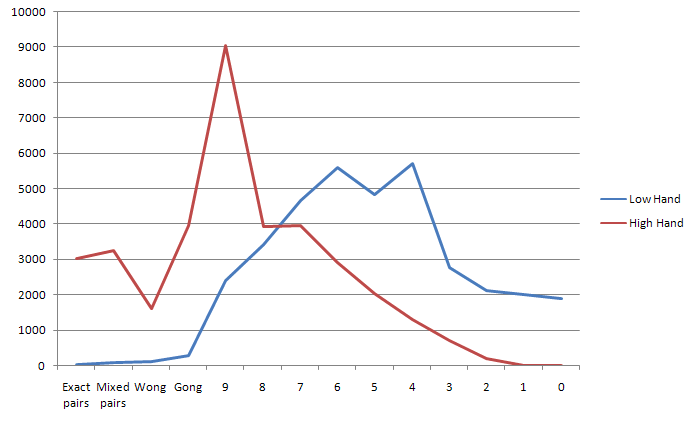
The following graph shows how often the House Way will make each type of hand out of all 35960 combinations.
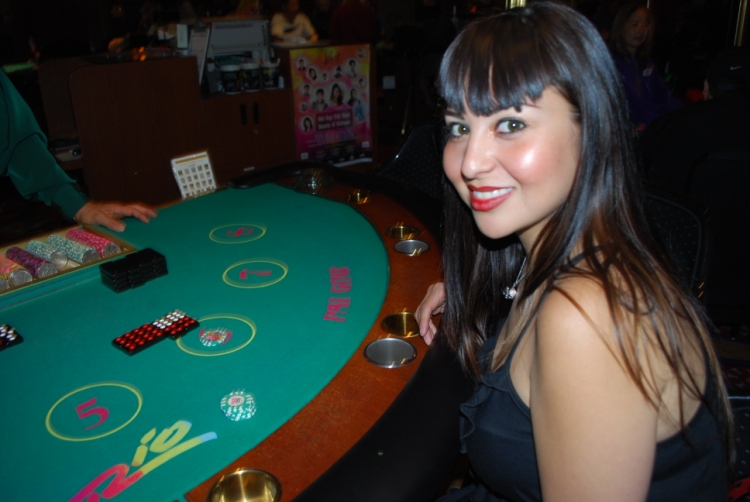
Suzie with a rare two pair.
The House Way
I'm proud to provide the following pai gow house ways. Most of them were rewritten into my own words. The one from the MGM is taken directly from their own rules and procedures on the game:
- Foxwoods
- Taj Mahal
- MGM Grand (PDF -- 1,180 K)
- New Zealand
- Marina Bay Sands (Singapore) (PDF -- 483K)
Where to Play
The following is a list of games I am aware of in the U.S.. I'm sure there are some I don't know about. Feel free to tell me if you are aware of others.
- Las Vegas: Aria, Bellagio, Caesars Palace, Encore, Harrah's, Lucky Dragon, MGM Grand, Mirage, Palace Station, Palazzo, Paris, Rio, Venetian, and Wynn. The Treasure Island and Mandalay Bay don't staff a table on a regular basis any longer, but may open one if a whale requests it.
- Atlantic City: Most, if not all, casinos.
- Connecticut: Mohegan Sun, Foxwoods.
- Indiana: Hammond Horseshoe, Southern Indiana Horseshoe.
- Lake Tahoe: Harrah's.
- Maryland: Horseshoe Baltimore. (unconfirmed)
- Pennsylvania: Sands Bethlehem, Mount Airy Casino in Mt Pocono (unconfirmed), Mohegan Sun at Pocono Downs near Scranton (unconfirmed), Sugar House Casino in Philadelphia (unconfirmed), Valley Forge Casino near King of Prussia, and Parx Casino near Bensalem (unconfirmed).
- Reno: Peppermill, Silver Legacy.
Play for Fun
Pai gow is a game that cries out for a way to practice before making a fool of yourself and blowing your money in a casino. For this reason please try my pai gow game.

Side Bets
Internal Links
- The Legend Behind Pai Gow — The story behind the game.
- Pai Gow Game.
- Pai Gow Calculator.
Online Table Poker Casino Bonuses View All




External Links
- Pai Gow rules in Macau at WizardOfMacau.com.
- Where to play Pai Gow at Harrah's properties.
Acknowledgements
- Pai Gow Without Tears by Bill Zender. The author kindly gave me a copy of his booklet to help with my research on pai gow. If you are interested in the book it may be purchased from the Gambler's Book Club for $20.00.
- A Detailed Study of Pai Gow by Dr. John M.Gwynn, Jr. This study appears in the book Finding the Edge (Edited by Olaf Vancura, Judy A.Collins, and William R. Eadington).
- The many people who supplied me with house ways, which are not easy to get.