
Wizard Recommends
-
 $11000 Welcome Bonus
 -
 $3000 Welcome Bonus
 -
 UP TO $777 BONUS
On this page
Spanish 21
Introduction
Spanish 21 is a variation of blackjack, that in some cases is the best bet in the casino. In locations where the dealer stands on a soft 17, or redoubling is allowed, Spanish 21 may be a better bet than blackjack, depending on the specific blackjack rules. If you are looking for a change of pace from traditional blackjack but insist on a game with a low house edge, then you may find new excitement in Spanish 21.
In Australia and Malaysia, Spanish 21 is called Pontoon. There are some rule changes in Australia, which merit a separate page. For all the details please visit my page on Australian Pontoon. To make matters more confusing, there is another similar game, but different enough to warrant a separate page, called Player's Edge 21.
Following is a list of known aliases of the game:
- Betsoft, a major provider of software for Internet casinos, offers Spanish 21 under the name Pirate 21.
- The Casino Bregenz in Austria changes the name to Blackjack Exchange.
- The Seven Cedars casino in Washington state calls the game Bahama Bonus Blackjack
The Rules
Spanish 21 uses six or eight Spanish decks, each deck consisting of 48 cards — the regular 52 cards less the four tens. Any card counter can tell you that removing any 10-point card from the cards moves the odds in favor of the dealer. To make up for this, Spanish 21 gives the player a host of bonuses and favorable rules. There are lots of Spanish 21 games all over the country, so rules will vary somewhat from place to place, but the usual rules in the player's favor are:
- Late surrender allowed.
- Double after split allowed.
- Re-splitting aces allowed.
- A player 21 always wins.
- Player blackjack beats dealer blackjack.
- Player may double on any number of cards.
- Player may usually hit and double down after splitting aces.
- Player may surrender after doubling, known as "double down rescue." The player forfeits an amount equal to his original bet.
- A five-card 21 pays 3 to 2, a six-card 21 pays 2 to 1, a seven or more card 21 pays 3 to 1. Bonus not honored after doubling.
- A 6-7-8 or 7-7-7 of mixed suits pays 3 to 2, of the same suit pays 2 to 1, and of spades pays 3 to 1. These bonuses do not pay after doubling.
- Suited 7-7-7 when the dealer has a seven face up pays $1000 for bets of $5-$24 and $5000 "Super Bonus" for bets of $25 or over. In addition, all other players receive a $50 "envy bonus." This bonus does not pay after doubling or splitting.
Variable Rules
- Dealer may hit or stand on a soft 17.
- 6 or 8 Spanish decks can be used.
- Some casinos allow redoubling, up to three times.
- I have heard of some casinos not allowing surrender or drawing to split aces, but it isn't the norm.
- A face card and ace after splitting has been known to count as a blackjack, at at least one casino.
- There has been a lot of debate through the years whether the bonuses are payable after a split. First, there is almost no argument that they do not pay after doubling. However, the way the game was designed, all bonuses except the Super Bonus are supposed to be payable after splitting. However, most casinos do not pay the bonuses after a split. The effect of not allowing the bonuses after splitting is very small, around 0.01%.
Strategy
Following is my Spanish 21 basic strategy when the dealer hits a soft 17.
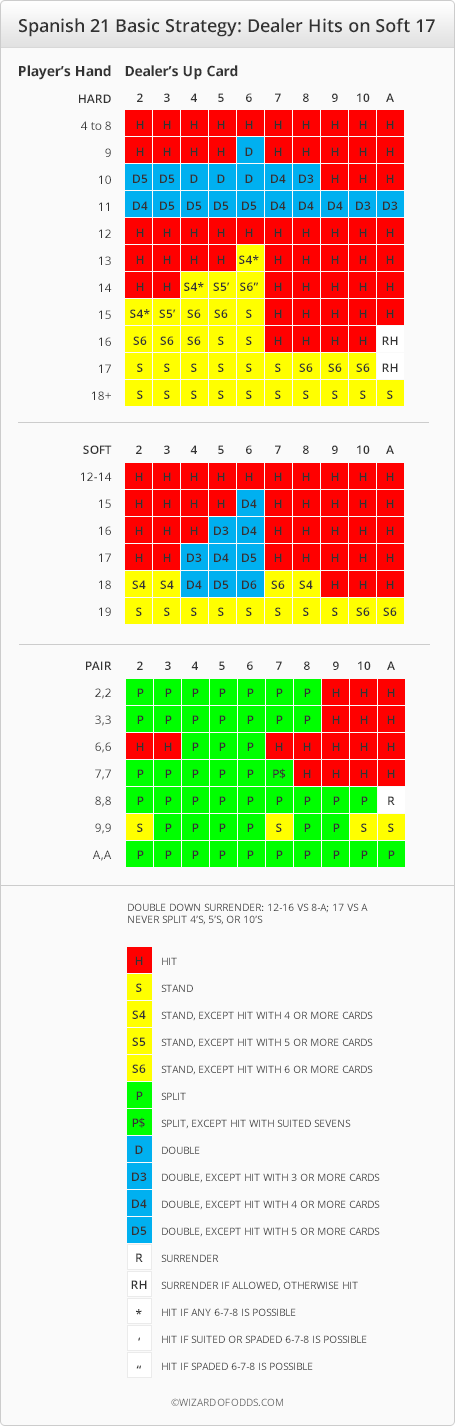
Next is the Spanish 21 basic strategy when the dealer stands on a soft 17.
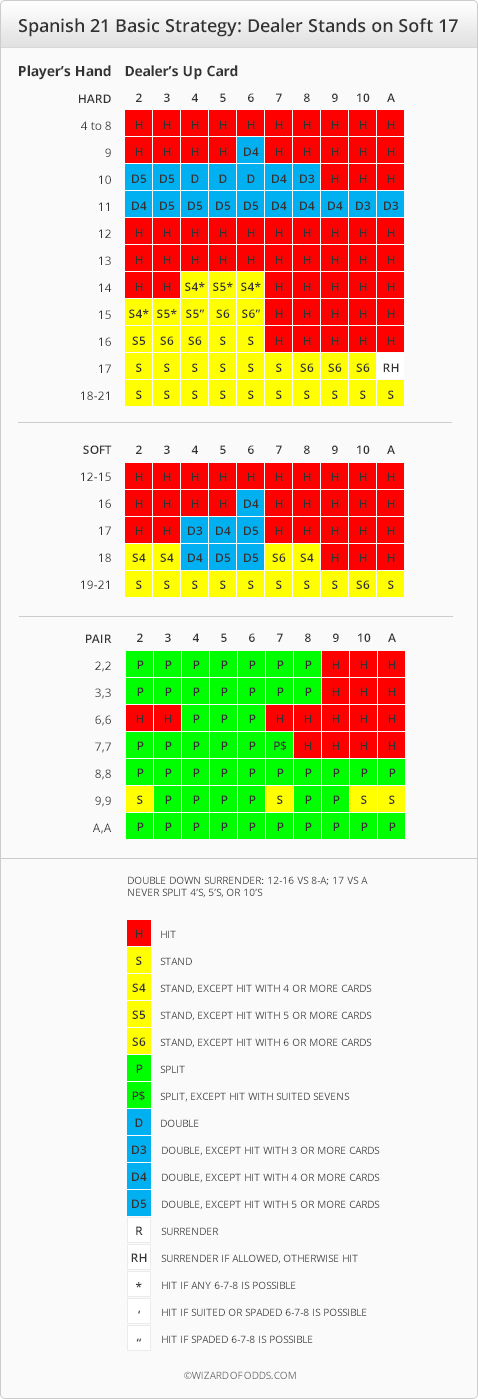
Note: If drawing to split aces is not allowed, and the dealer stands on soft 17 (as is the case at the Mohegan Sun), then hit A,A vs A.
The next table if for when the dealer hits a soft 17, redoubling is allowed, and the player has not already doubled.
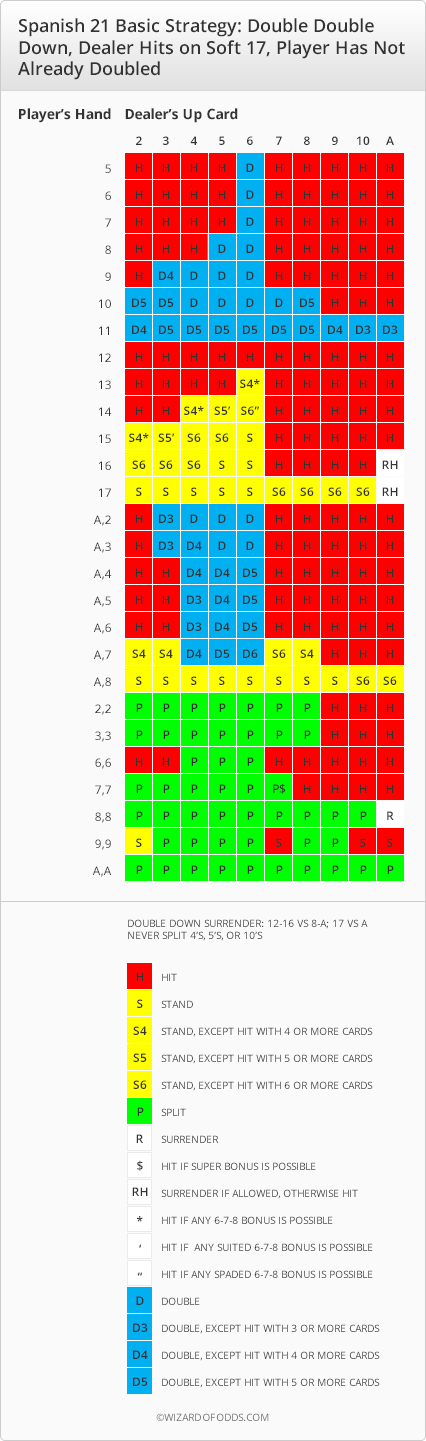
The next table if for when the dealer hits a soft 17, redoubling is allowed, and the player has already doubled, which limits his options to stand, surrender, and double again.
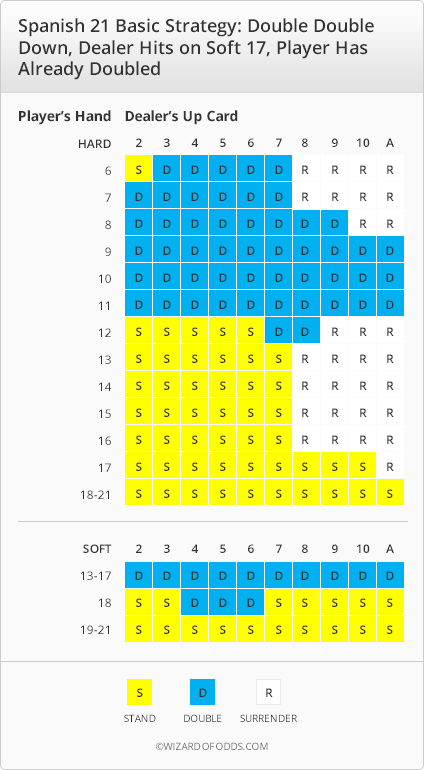
Many readers have expressed doubt about my advice to hit 17 against an ace with 3 or more cards. However, I stand by what I said. The player will save about 2.8% of the initial wager by hitting as opposed to standing. The dealers will advise against this play and the other players may curse the day you were born, but trust me, the odds favor hitting.
House Edge
- Dealer stands on soft 17: 0.40%
- Dealer hits on soft 17, redoubling allowed: 0.42%
- Dealer hits on soft 17, redoubling not allowed: 0.76%
Super Bonus
The probability of hitting the Super Bonus is 1 in 668,382, with six decks, and 1 in 549,188 with eight decks. The reduction in the house edge depends on the bet amount, and to a lesser extent, the number of players. With no other players, and bets of exactly $5 or $25, the Super Bonus lowers the house edge by 0.030% in a six-deck game, and 0.036% in an eight-deck game. At a bet of exactly $5, the Envy Bonus lowers the house edge by an additional 0.0015% in a six-deck game, and 0.0018% in an eight-deck game, per additional player.
For bet amounts other than those indicated above, the benefit of the Super Bonus will go down as the bet amount goes up.
Rule Variations
No Draw to Split Aces: At the Mohegan Sun drawing to split aces is NOT allowed. The effect of this rule is to increase the house edge by 0.29%.
Ace and 10 after splitting aces pays 3 to 2: I have an unconfirmed report that at at one time the Meskaki casino in central Iowa paid 3 to 2 on an ace and 10 after splitting aces. I have another unconfirmed report that as of Aug. 2010 they removed the Spanish 21 table completely. According to my calculations this lowers the house edge by 0.16%. Otherwise they hit a soft 17 and no redoubling, for an overall house edge of 0.60%.
Doubling only allowed on first two cards: I had a false report that a casino in Malaysia didn't allow doubling on any number of cards. If such a rule did exist, it would increase the house edge by 0.16%.
Match the Dealer
Match the Dealer is a side bet found in both blackjack and Spanish 21. The player wins for each of his initial two cards that match the dealer's up card. Matches in rank only pay less than a match in rank and suit. The following tables show the various pay tables that I am aware of for Spanish 21.
Match the Dealer — Six Decks
| Event | Combinations | Probability | Pays | Return |
|---|---|---|---|---|
| Two suited matches | 10 | 0.000244 | 18 | 0.004386 |
| One hard and one each match | 90 | 0.002193 | 13 | 0.028508 |
| Two non-suited matches | 153 | 0.003728 | 8 | 0.029824 |
| One suited match | 1320 | 0.032163 | 9 | 0.289467 |
| One non-suited match | 4752 | 0.115787 | 4 | 0.463147 |
| No matches | 34716 | 0.845886 | -1 | -0.845886 |
| Total | 41041 | 1 | 0 | -0.030555 |
Match the Dealer — Eight Decks
| Event | Combinations | Probability | Pays | Return |
|---|---|---|---|---|
| Two suited matches | 21 | 0.000287 | 24 | 0.00689 |
| One hard and one each match | 168 | 0.002297 | 15 | 0.034448 |
| Two non-suited matches | 276 | 0.003773 | 6 | 0.022637 |
| One suited match | 2464 | 0.033683 | 12 | 0.404194 |
| One non-suited match | 8448 | 0.115484 | 3 | 0.346452 |
| No matches | 61776 | 0.844477 | -1 | -0.844477 |
| Total | 73153 | 1 | 0 | -0.029855 |
C4
The Casino Bregenz in Austria offers Spanish 21 but calls it Blackjack Exchange. They tack on a side bet called the C4, which is analyzed below. The table is based on six decks and assumes that if the player qualifies for more than one win, he only gets the higher win. The lower right cell shows a house edge of 14.48%.
C4 — Six Decks
| Event | Combinations | Probability | Pays | Return |
|---|---|---|---|---|
| Four of a kind | 500 | 138,138 | 0.000337 | 0.168467 |
| Straight | 20 | 3,649,536 | 0.008902 | 0.178032 |
| Flush | 12 | 5,647,896 | 0.013776 | 0.165310 |
| Two pair | 10 | 5,941,728 | 0.014492 | 0.144925 |
| Three of a kind | 8 | 7,330,752 | 0.017880 | 0.143044 |
| All other | -1 | 387,278,420 | 0.944613 | -0.944613 |
| Total | 409,986,470 | 1.000000 | -0.144836 |
Following is the house edge of the C4 for other numbers of decks.
- Four decks: 18.49%
- Eight decks: 12.41%
Methodology
The Spanish 21 strategy found here is based on a combinatorial program which considered both card composition and the six deck nature of the game. In addition an infinite deck model was created in Excel, of which the basic strategy nearly agreed with that of the combinatorial model. The basic strategy found here does not agree with that of the late Lenny Frome in some borderline situations. Frome's strategy can be found in such books as 'Secrets of the New Casino Games' (Marten Jensen) and 'Armada Strategies for Spanish 21' (Frank Scoblete). Although I have a great deal of respect for Frome and his body of work, I strongly feel that his basic strategy is incorrect. I speculate he did notincorporate the double down surrender feature correctly into his analysis. My strategies also agree with those of Katarina Walker, who has done an amazing job analyzing Spanish 21 and its cousin, Australian Pontoon, as well as an independent analysis by Mike Hopson.
Acknowledgments
I would like to give a huge thanks to Katarina Walker for correcting some minor strategy errors in this page. She is the author of The Pro's Guide to Spanish 21 and Australian Pontoon.
Links
German translation of this page.