
Wizard Recommends
-
 $11000 Welcome Bonus
 -
 $3000 Welcome Bonus
 -
 UP TO $777 BONUS
On this page
J.B. Advanced Strategy for Pai Gow
Introduction
I'm proud to feature the following pai gow strategy by "J.B.", that I commissioned and advised on. It was created in an effort to balance power and simplicity. The reason it was created was I received too many complaints, including from myself, that my own Wizard Way was too difficult to memorize. The user can start using this strategy almost immediately, learning only a few easy rules, with the option to add exceptions later.
The strategy is optimized to beat the Foxwoods house way. However, it should work fine against any house way. To use it, follow the first rule on the list that applies. A printer friendly version of this strategy is also available in PDF format (127K).
- Never split two pairs.
- Play individual pairs as follows:
Rules for Splitting Pairs
Pair Rule Gee Joon Only split when the other tiles are a 6 and 4, 5, or 6. 2s and 12s Only split to make 6/8 or better if it improves the low hand. Also split with 9 and 11. Do not split with 9 and High 8. 4s Never split. 5s Only split when the other tiles are 2 and 12. 6s Only split with any combination of 2, 11, 12. 7s Only split to make 7/7 or better. 8s Only split to make 8/8 or better. Also split with 9 and 11. 9s Only split to make 9/9 or better. 10s and 11s Never split. - Counting Wongs as 11 points and Gongs as 10 points, add the number of points in each high hand to the number of points in its corresponding low hand. Determine the highest point total of the three ways to play. If there is only one way to play the highest point total, play it.
- Play 0/Wong, 1/Gong, and 1/Wong whenever possible.
- Play High Nine whenever possible. If given a choice between 2 and 12, play the 12 in the high hand. If given a choice between Low 7 and High 7, play the High 7 in the low hand if it improves it.
- Play a Low 8 Gong whenever possible, except when you also have a High 8 and cannot use it to make a low hand of 7 or better. If given a choice between 2 and 12, play the 12 in the high hand.
- Determine the best low hand and best high hand by comparing only those ways to play which have the highest point total. Play the best low hand if the point totals is 5 or less, or if the best low hand is worth 5, 6, 7, or 9 points. Play the best high hand in all other circumstances.
Exceptions
Reduction in House Edge
| Exception | Dealer Banker | Player Banker |
|---|---|---|
| Whenever possible, play 5/7, 6/7, or 7/7 instead of High Nine when the tiles include a 2 with any 4, 5, or 8. | 0.0393% | 0.0181% |
| With 6-point hands, play 3/3 if possible, otherwise play the best high hand. | 0.0298% | 0.0155% |
| With 9-point hands, play the best low hand if the best high hand is a 6, otherwise play the best high hand. | 0.0260% | 0.0274% |
| Play a Low 8 Gong instead of High Nine when the fourth tile is a Gee, 4, 5, High 10, or 11. | 0.0139% | 0.0140% |
| With 11-point hands where the best low hand is a 4, play 4/7 if any tile is a Gee. | 0.0129% | 0.0138% |
| With 10-point hands, always play 1/9 whenever possible, except when the tiles include a 5 and 10. | 0.0110% | 0.0101% |
| With 8-point hands, always play 4/4 if the tiles include two 7's without a 10. | 0.0107% | 0.0104% |
| With 7-point hands where 0/7 is not an option, always play 3/4 whenever possible. | 0.0083% | 0.0091% |
| Play Wong instead of High Nine when the fourth tile is a 5, or when the tiles include a 2 and High 10. | 0.0062% | 0.0020% |
| Split a pair of Low 6's when the other two tiles are High 10 with a 2 or 12. | 0.0008% | 0.0013% |
| When banking, do not split a pair of High 7's when the other tiles are 10 and 10. | N/A | 0.0001% |
Note: the figures above assume a 5% commission.
Addendum
There are certain combinations of tiles which may appear to have multiple ways to play, when in fact there is only one. Consider the following examples:
- Low 7, High 7, Low 10, High 10
Your choices are 0/4, 7/7, and 7/7. Clearly 0/4 is inferior and should never be played. But since both 10s are higher in rank than both 7s, it does not matter which 7/7 you choose, since the 7 with the High 10 will always be the high hand, and the 7 with the Low 10 will always be the low hand. Therefore, there is technically only one way to play this combination of tiles.
- Gee, Low 6, High 6, 12
Your choices are 2/8, 8/9, and 8/9. The 2/8 is inferior and should never be played, but there is a significant difference between the two ways to play 8/9. The two acceptable low hands are formed by playing the 12 with either the Low 6 or the High 6. Regardless of which 6 you use in the low hand, the points and rank are identical. However, the high hand is lower in rank with the Gee and Low 6 than with the Gee and High 6. Therefore, the correct way to play this hand is to put the 12 and Low 6 in the low hand, and Gee and High 6 in the high hand, making that the only way to play this combination of tiles.
- Low 10, High 6, High 10, High 8
Your choices are 0/4 (inferior), 6/8, and 6/8. The low hand should consist of the High 6 and High 10, and the high hand should consist of the Low 10 and High 8. It would be a waste of the High 10 to play it with the High 8 because the High 8 is the highest tile no matter which 10 you play with it. The low hand, however, is improved by playing the High 10 instead of the Low 10. This is the only way to play this combination of tiles.
The same applies with combinations that appear to have three ways to play, but in fact only have two. Consider the following examples:
- Low 6, High 7, High 6, 2
Your choices are 2/9, 3/8, and 3/8 - but only one of the 3/8 ways is valid. If you play the 2 and High 6 in the high hand, the low hand's rank is significantly reduced. The Low 6 can be played in the high hand without affecting it, while improving the low hand at the same time. Thus, there are only two ways to play this hand: 2/9 (both 6's in the low hand) and 3/8 (High 6 and High 7 in the low hand).
- Low 10, High 6, High 10, 12
Your choices are 0/8, 2/6, and 2/6, however only one of the 2/6 ways is acceptable. It would be wasteful to play the High 10 with the 12, since the low hand would not be weakened by playing the Low 10 with the 12. Thus, the two acceptable ways to play this hand are 0/8 (both 10's in the low hand) and 2/6 (the 12 and Low 10 in the low hand).
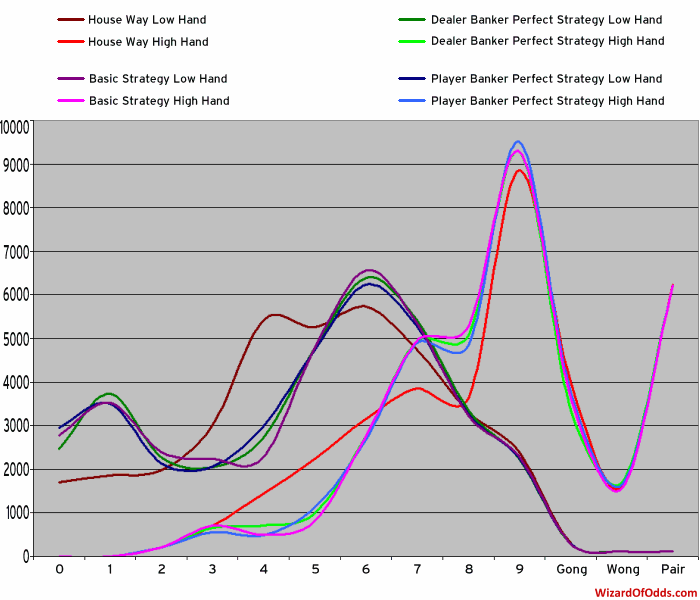
Chart
This following chart shows how often each type of hand is made for the Foxwoods house way, as well as perfect strategy and basic strategy (including the exceptions) when the dealer is banking and when the player is banking:
House Edge
The following table shows the house edge using the J.B. strategy, with and without the exceptions, as well as some other strategies. The table assumes the player is pre-paying the commission, which he should do, if allowed. If the player does not pre-pay the commission, add 0.07%.
Pai Gow House Edge
| Strategy | Banking | House Edge |
|---|---|---|
| Optimal | Yes | -0.27% |
| J.B. with exceptions | Yes | -0.15% |
| J.B. without exceptions | Yes | -0.03% |
| Wizard Way | Yes | -0.05% |
| House Way | Yes | 0.46% |
| Optimal | No | 1.60% |
| J.B. with exceptions | No | 1.71% |
| J.B. without exceptions | No | 1.86% |
| Wizard Way | No | 1.81% |
| House Way | No | 2.37% |